


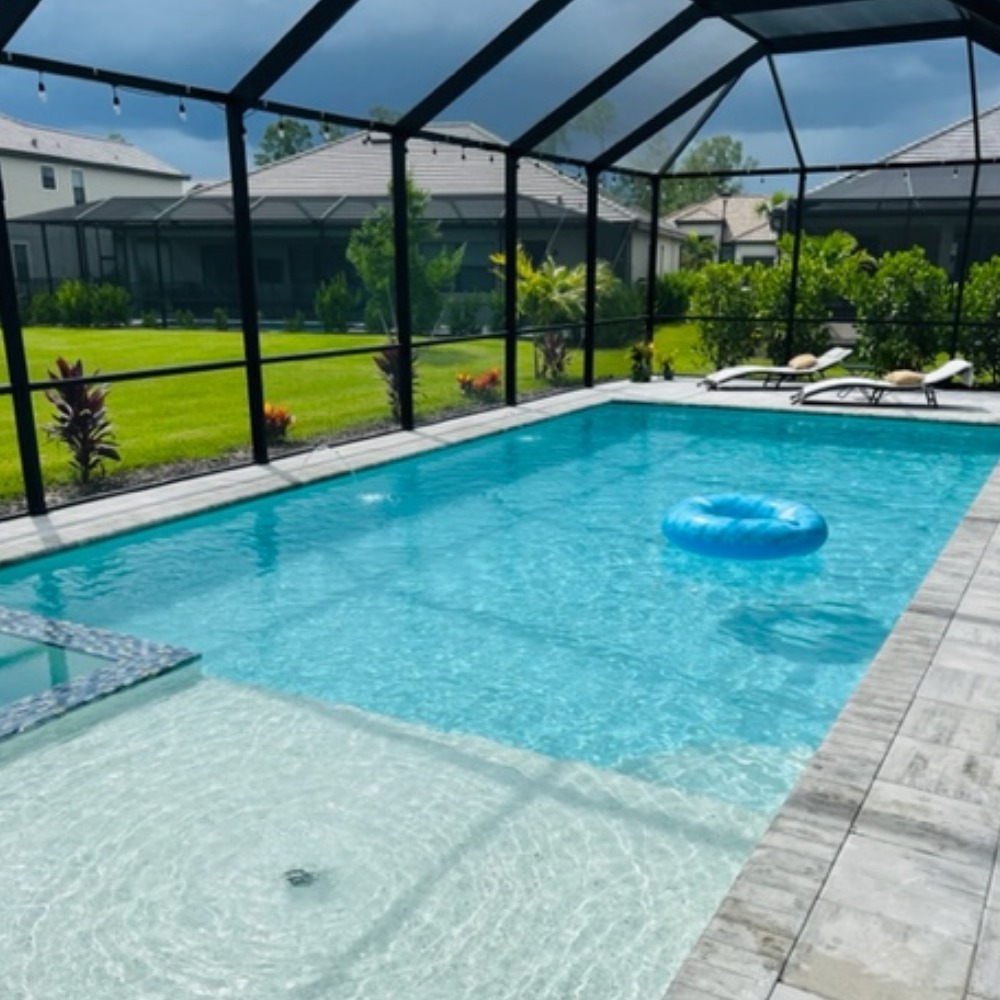
You walked out to the lanai this morning, coffee in hand, and your pool looked like a swamp. Yesterday it was clear. Today it’s green. If you own a pool in Fort Myers, you already know this feeling, and you’re not alone. A green pool in Fort Myers is the single most common call we get between May and October, and there’s a specific reason it happens here more than almost anywhere else in the country.
Heat, humidity, summer rain, pollen, and our long swim season give algae a near perfect environment to bloom. The good news: a green pool is fixable, usually within 24 to 72 hours, and once you understand what causes it, you can stop it from happening again. This guide walks you through exactly what’s going on in your water, how to clear it step by step, what it costs, and when it’s worth calling someone instead of buying another bucket of shock at the hardware store. We’ve cleared thousands of green pools across Lee and Collier County, and almost every one comes down to the same handful of root causes, most of which have nothing to do with how much chemical you’re adding.
Quick Answer
A green pool in Fort Myers is caused by algae growing when chlorine drops below 1 ppm, usually after heavy summer rain, high heat, or a pump that isn’t running long enough. To fix it, brush every surface, balance pH to 7.2-7.4, shock with chlorine to 10+ ppm, run the pump 24 hours, and clean or backwash the filter. Most pools clear in 2-3 days.
Table of Contents
- What Actually Causes a Green Pool
- Why Fort Myers Pools Turn Green Faster
- The 3 Types of Algae You’ll See in SW Florida
- How to Fix a Green Pool, Step by Step
- How Long It Takes to Clear
- DIY vs. Calling a Pro: Honest Comparison
- How to Prevent It From Happening Again
- When Equipment Is the Real Problem
- What It Costs to Clear a Green Pool
- Frequently Asked Questions
What Actually Causes a Green Pool
A green pool is algae. That’s it. Algae are microscopic plants that exist in the air, on your skin, on pool toys, in rainwater, on every leaf that blows into your screen enclosure, and even on the bottom of flip flops people walk into the pool with. They’re always trying to grow. The only thing stopping them is the sanitizer in your water, usually chlorine.
When free chlorine drops below 1 part per million (ppm), algae can multiply fast. Under the right conditions, a single algae cell can become more than a million cells in 24 hours. In Fort Myers heat, “fast” means a clear pool on Friday can be visibly green by Sunday afternoon. We’ve watched pools go from crystal clear at 9 a.m. on a Saturday to cloudy green by Monday morning after a hot, sunny weekend with a brief afternoon storm. That’s how narrow the window is in our climate.
Three things almost always cause the chlorine drop that lets algae take over:
- Heavy summer rain dilutes chlorine and lowers cyanuric acid (CYA), the stabilizer that protects chlorine from UV. A single afternoon thunderstorm can dump an inch of untreated water into your pool in under an hour, dropping your free chlorine reading noticeably even if everything else is dialed in.
- Hot, sunny days burn off chlorine fast, Florida UV destroys unstabilized chlorine in under two hours. On a 92°F day with full sun, your pool can lose 3-5 ppm of chlorine between sunrise and sunset if CYA is too low.
- A pump not running long enough means treated water never circulates to where algae are starting to bloom. Algae loves dead zones, corners, behind the ladder, under the skimmer lip, around stairs, and along the shaded side of the pool where the sun rarely hits.
You can have perfect chemistry on Monday and a green pool on Friday if any one of those three lines up wrong. That’s the part most homeowners don’t realize, pool chemistry isn’t static. It changes daily, sometimes hourly, in our climate. A reading from last weekend tells you almost nothing about what’s happening in the water right now. This is also why pool stores can’t reliably solve a recurring green pool problem from a single water sample, the sample only captures one moment in a constantly shifting system.
There’s also a fourth, sneakier cause we see often in Fort Myers: phosphates. Phosphates are algae food. They enter pools through fill water, lawn fertilizer runoff, leaves, pollen, and even some pool chemicals. When phosphate levels climb above 500 ppb, you can have textbook perfect chlorine readings and still get algae blooms, because the algae is growing faster than the sanitizer can keep up. Most homeowners never test for phosphates, which is why they stay stuck in a cycle of “the chemistry looks fine but my pool keeps turning green.”
Rather not fight your pool chemistry every week?
Liquid Concepts provides flat-rate weekly pool service in Fort Myers and Cape Coral from $145/month, with a service report after every visit, no contracts and no upsells. Licensed CPC 1459893.
See weekly pool service → · Call (239) 216-0600
Pool already green? See green pool cleanup →
Why Fort Myers Pools Turn Green Faster Than Pools Up North
We’ve serviced pools across Fort Myers, Cape Coral, Lehigh Acres, Estero, and Bonita Springs for decades, and there are five Southwest Florida, specific factors that make our pools more algae prone than pools in Atlanta, Phoenix, or even Tampa. Homeowners moving down from up north are almost always surprised by how much more attention a SW Florida pool needs. A pool in Ohio might stay clear for two weeks with no service. A pool in Fort Myers can turn green in 72 hours.
1. Year round 75°F+ water
Algae growth roughly doubles for every 10°F rise in water temperature. Most Fort Myers pools sit between 82°F and 92°F from April through October. That’s prime algae weather almost six months of the year. By comparison, a pool in Georgia might only spend 8-10 weeks above 82°F. Ours spends six months there. The math is brutal, more warm days means more chemical demand, more circulation needs, and more chances for algae to get a foothold.
2. Daily summer rain
From June through September, Fort Myers averages an afternoon thunderstorm almost every day. Each one dumps untreated water into your pool, dilutes chlorine, and washes pollen, leaves, and debris off your screen enclosure into the water. Heavy storms also raise water levels above the skimmer line, which kills surface skimming until you can drain off the excess. Multiple back to back storm days, which happen often in August and September, can knock chlorine down to zero overnight even on a pool that was dialed in 48 hours earlier.
3. Intense UV index
Our UV index regularly hits 10-11 in summer, which is the upper end of the scale. Without proper CYA (30-50 ppm for chlorine pools, 60-80 ppm for salt), chlorine gets destroyed by sunlight in under two hours, leaving your pool unprotected most of the day. We see pools with CYA at 10 ppm or less constantly, usually because heavy rain washed it out and nobody added more. Those pools burn through chlorine three times as fast as a properly stabilized pool, and the owner usually doesn’t realize that’s why they keep losing the battle.
4. Hurricane season debris
Even minor tropical storms blow organic material, leaves, palm fronds, pollen, dust, and the gunk that accumulates on screen enclosure panels, into the water. Every leaf is algae food. After a real hurricane or named storm, we often see pools that look fine the day after but turn green a week later because of the phosphate load left behind by organic debris decomposing in the water.
5. Long pollen season
Oak pollen, pine pollen, and slash pine debris coat SW Florida pools from February through May. The yellow film you see on cars in spring is the same stuff settling into your pool. Once it sinks, it feeds whatever algae is already trying to take hold. Pollen also raises phosphate levels, which is why we test phosphates more aggressively in spring than any other time of year.
Add up these five factors and you have a climate that demands more from a pool than almost anywhere else in the country. That’s not a sales pitch, it’s a fact. A pool here needs more chlorine, more circulation, more brushing, more filtration, and more attention than a pool anywhere north of I 10. If you’re treating your Fort Myers pool the way you treated a pool you owned in another state, you’ll always be playing catch up.
The 3 Types of Algae You’ll See in SW Florida Pools
Not all green is the same green. Identifying which type you have changes how aggressively you need to treat it, how much chlorine you’ll need, and how long it’ll take to clear. Treating black algae with a green algae protocol is one of the most common mistakes we see, homeowners shock the pool three times, watch it clear, then see the black spots return because they never broke the protective layer the algae builds on the plaster surface.
| Algae Type | What It Looks Like | Difficulty | Typical Clear Time |
|---|---|---|---|
| Green algae | Cloudy green water, slick walls, free floating | Easy | 24-72 hours |
| Yellow / mustard algae | Dusty yellow patches on shaded walls and steps | Moderate | 3-5 days |
| Black algae | Dark green black spots with hard root structure, common in plaster pools | Hard | 7-14 days |
Green algae is what 80% of our Fort Myers green pool calls turn out to be. It floats freely in the water, makes the pool look cloudy or pea soup green, and feels slippery on the walls and floor. It’s the easiest to treat because it doesn’t form a protective coating, chlorine can reach it directly. A standard shock protocol clears it in two to three days.
Mustard algae (also called yellow algae) is sneakier. It looks like dust or pollen clinging to the shaded walls, usually the south facing wall of the pool, behind ladders, around steps, and in spots that don’t get direct sun. Many homeowners brush it off thinking it’s pollen, watch it disappear, then see it come back in 24 hours. Mustard algae is chlorine resistant, which means standard shock levels don’t kill it. It needs free chlorine above 20 ppm for 24+ hours, plus aggressive brushing, plus a full filter cleaning afterward. Without those three things together, mustard algae always comes back.
Black algae is the worst case scenario. It shows up as dark green or black spots, usually the size of a dime to a quarter, with a hard, rooted structure that grows into porous surfaces like plaster, grout, and rough tile. Black algae builds a waxy protective layer that ordinary chlorine can’t penetrate. Killing it requires breaking that layer mechanically (a wire brush or a pumice stone), then maintaining super chlorination for several days. Black algae is more common in older Fort Myers pools with worn plaster, especially homes built in the 1980s and 1990s that haven’t been resurfaced.
If you’re not sure which type you have, look at the walls. Free floating cloudy green = standard algae. Spots or patches that won’t brush off easily = mustard or black. When in doubt, treat it as the more difficult kind, under treating mustard or black algae just wastes chemicals and time.
How to Fix a Green Pool, Step by Step
Here’s the exact sequence we follow on a green- pool service call. Order matters. Skipping steps is why some homeowners stay stuck shocking a pool that won’t clear. We’ve seen homeowners pour $300 worth of chemicals into a pool over a week and still have green water because they shocked before balancing pH, or never brushed, or didn’t clean the filter. Do these eight steps in order and the pool clears.
Test the water
Test free chlorine, pH, total alkalinity, CYA, and phosphates. You can’t fix what you can’t measure. A good drop kit or test strip works, pool store water tests are fine too but bring a fresh sample.
Balance pH first
Drop pH to 7.2-7.4 before shocking. Chlorine works up to 10x better at low pH than at 7.8+. Use muriatic acid or dry acid, add slowly with the pump running.
Brush every surface
Walls, floor, steps, behind ladders, under the skimmer lip. Brushing breaks the algae cell wall so chlorine can kill it. Use a stainless brush on plaster pools, nylon on vinyl or fiberglass.
Shock the pool
Raise free chlorine to 10+ ppm. For mustard or black algae, go to 20+ ppm. Use liquid chlorine (12.5% sodium hypochlorite) for fastest results, it doesn’t add CYA the way granular shock does.
Run pump 24 hours
Circulation is non negotiable. Run the pump continuously until the water clears, not just your normal 8 hours. Open all return jets fully and point them slightly downward for better mixing.
Clean the filter
Backwash sand/DE filters every 12 hours during cleanup. Pull cartridge filters and hose them out, or chemically soak overnight. Dead algae clogs filters fast and stops circulation.
Brush again at 24 hrs
Knock loose dead algae so the filter can grab it. Vacuum to waste if you have heavy sediment, running it through the filter just clogs it faster.
Rebalance everything
Once clear, retest. Bring chlorine to 1-3 ppm, pH to 7.4-7.6, alkalinity to 80-120 ppm, CYA to 30-50 ppm (60-80 for salt pools), calcium hardness 200-400 ppm.
A few critical notes that don’t fit on a step card: never mix different chemicals in the same bucket or skimmer. Always add chemicals to water, never water to chemicals. If your pool has a salt system, switch the cell off during the shock process and use liquid chlorine, running the cell while super chlorinating shortens its life. And don’t put anything else in the water (no clarifier, no algaecide, no phosphate remover) until after the shock has done its job and chlorine is back to normal range. Stacking chemicals on top of a shock cycle just neutralizes the chlorine and slows the whole process down.
“Most green pools we clear in Fort Myers aren’t a chemistry mystery, they’re a circulation problem or a pump runtime problem. Get the water moving, and the rest follows.”
How Long It Takes a Green Pool to Clear
Once you’ve shocked properly and the pump is running, here’s what you should see. The pool goes through predictable visual stages as the algae dies, falls out of suspension, and gets caught by the filter. Knowing the stages helps you know whether you’re on track or stuck.
Typical Green Pool Clearing Timeline
Based on standard green algae, properly shocked, pump running 24/7
The first 12 hours is the most dramatic visual change, the water shifts from bright algae green to a duller gray green or even teal as the algae cells die. A lot of homeowners panic at hour 12 because the pool actually looks worse, not better. That’s normal. Dead algae is still in the water, just no longer alive and reproducing. The next 24 hours is about getting it out of suspension and into the filter.
By hour 48, most of the dead algae has either been filtered out or settled to the bottom as a fine gray dust. You should be able to see the pool floor in the shallow end clearly, even if the deep end is still hazy. This is when a thorough vacuum to waste (if you have heavy settled debris) makes the biggest difference. Skip this step and you’ll filter the same dead algae through your cartridges three times.
By hour 72, the pool should be fully clear or very close to it. If you’re at 72 hours and still cloudy or still green, something else is going on, usually a failing filter, a circulation dead zone, high phosphates feeding regrowth, or mustard algae masquerading as standard green. That’s typically when homeowners call us for pool equipment repair or a diagnostic visit. We can usually identify the real bottleneck in 20 minutes on site, which is faster (and cheaper) than continuing to dump chemicals at the problem.
DIY vs. Calling a Pro: An Honest Comparison
We’re not going to pretend you can’t clear a green pool yourself. Plenty of homeowners do. We’ve talked Cape Coral and Lehigh Acres homeowners through green pool cleanups over the phone more times than we can count, and most of them figured it out. But there’s an honest tradeoff that’s worth thinking through before you decide which way to go.
| Factor | DIY | Professional Service |
|---|---|---|
| Upfront cost | $80-$200 in chemicals | $150-$350 service call + chemicals |
| Time investment | 6-10 hours over 3-5 days | One visit + monitoring |
| Equipment needed | Test kit, brush, vacuum, chemicals | All provided |
| Success rate (standard green) | High if instructions followed | Near 100% |
| Success rate (mustard/black) | Low, easy to misdiagnose | High |
| Diagnoses root cause | Usually no | Yes, equipment, runtime, chemistry |
Here’s how we’d actually frame the decision for a Fort Myers homeowner:
DIY makes sense if: this is your first or second green pool, you have a free weekend, you have a working pump and filter, you’re comfortable handling muriatic acid and liquid chlorine, and your water doesn’t have black or mustard algae. You’ll save $100-$200 and learn something useful about your pool.
Calling a pro makes sense if: you’ve already shocked the pool and it’s still green after 72 hours, you can’t identify the algae type, your equipment is old or you suspect a leak, you’ve had this same problem more than once this season, or you simply don’t want to spend the weekend with a brush in your hand in 95°F heat. Most professional green pool cleanups also include a full equipment inspection, which often surfaces the real root cause, and prevents the problem from happening again next month.
One more thing worth knowing: a lot of homeowners try DIY for a few days, give up, and then call a pro after spending $150 on chemicals that didn’t work. At that point you’re paying for both. If you’re going to attempt it yourself, give it one focused, properly sequenced attempt. If it doesn’t work in 72 hours, call somebody. Spending two weeks shocking the same pool is the most expensive way to handle it.
How to Prevent It From Happening Again
Once your pool is clear, prevention is mostly about consistency. The homeowners we serve who never see a green pool, even during the worst of hurricane season, all do the same five things. None of them are complicated. The hard part is doing them every single week, in 95°F heat, year round.
- Maintain free chlorine at 1-3 ppm at all times. Not “most of the time.” Always. This is the foundation. If chlorine ever hits zero, algae has a window. In Fort Myers summer, that window can be as short as one hot afternoon.
- Keep CYA between 30-50 ppm (60-80 for salt pools). Too low and UV kills chlorine; too high and chlorine can’t sanitize effectively. CYA is the most overlooked number in pool chemistry, and the one that causes the most recurring green pools in our climate.
- Run the pump 8-12 hours a day in summer. Less in winter (6-8 hours is usually fine). Skimping on runtime is the #1 cause of repeat green pools we see in Fort Myers. Many pools come pre set to 4-6 hours from the builder, which simply isn’t enough for our heat.
- Brush the pool at least once a week. Algae starts on walls and steps before it ever turns the water green. A weekly brush in the right spots (shaded walls, steps, behind ladders, corners) catches algae before it becomes a visible bloom.
- Test water 2x per week minimum. Or have a service that does it for you and documents it. Most homeowners think their water is fine because the pool looks fine, but a pool can lose all of its chlorine and still look clear for a day or two. By the time it shows up visually, the bloom is already in motion.
There are also a few less obvious prevention habits that matter more in SW Florida than anywhere else: rinse off the screen enclosure with a hose every few weeks during pollen season, empty skimmer baskets after every storm (not once a week), keep an eye on water level after heavy rain so the skimmer can still draw, and check phosphates twice a year, especially if you have a lawn service that fertilizes regularly. A neighbor’s fertilizer can become your phosphate problem if runoff hits your lanai.
This is why our weekly pool service includes a 12 photo report after every visit, chemistry readings, equipment status, water clarity, skimmer baskets, filter pressure, and any issues we caught early. You shouldn’t have to wonder what was done to your pool. As a family owned pool company in Fort Myers, we’ve found that transparency is the difference between a pool that stays clear and one that surprises you on a Saturday morning. The 12 photo report exists because we got tired of homeowners asking us “did anyone actually come this week?”, a question they should never have to ask.
When Equipment Is the Real Problem
If you’ve shocked your pool more than twice in a season and it keeps turning green, the issue is almost never chemistry. It’s almost always something mechanical. We see this constantly, homeowners who have been fighting the same pool for months, spending hundreds on chemicals, when the actual problem is a $15 part or a 30 second timer adjustment. Here are the most common equipment side culprits we find on green pool diagnostic visits:
Common equipment culprits
- Failing pump running but moving less water than rated, sounds normal, just isn’t pushing enough volume
- Old or torn cartridge filter letting algae back into the pool every time the pump runs
- Salt cell at end of life not producing enough chlorine no matter how high you set it
- Cracked skimmer weir reducing surface circulation and letting debris bypass the basket
- Plumbing leak drawing air and losing prime overnight, so the pump runs dry for hours
- Pump timer too short, common after a power outage resets the clock
- Clogged impeller reduces flow rate dramatically even with a strong sounding pump
- Multiport valve bypass on sand filters that’s leaking water back into the pool unfiltered
Any of these will cause repeat algae blooms no matter how much chlorine you throw at the water. A pump that’s only moving 60% of its rated flow rate effectively gives you 60% of your pump runtime, even if it runs the full schedule. A torn cartridge lets dead algae back into the pool faster than the filter removes it. A weak salt cell can read “OK” on the panel but only produce a fraction of the chlorine it should.
This is the most common reason homeowners in Cape Coral and Lehigh Acres switch to a real Fort Myers pool service after fighting the same pool all summer. The first time we walk in, we usually find the issue in the equipment pad, not the water. We’ll measure filter pressure, check pump amperage, look at cell output, listen for air in the lines, and look at the timer. Most diagnostic visits take 20-30 minutes and answer questions homeowners have been chasing for months.
If you’ve shocked twice and it’s still happening, stop buying chlorine and start looking at the equipment. Or call somebody who will. Chemicals can’t fix a mechanical problem, no matter how many gallons you pour in.
What It Costs to Clear a Green Pool in Fort Myers
Pricing varies based on pool size, algae severity, and what equipment work might be involved. Here’s an honest range based on what we see in the Fort Myers, Cape Coral pool service area, Estero, Bonita Springs, and Lehigh Acres markets. These numbers reflect a typical 12,000-18,000 gallon residential pool, the most common size in SWFL.
| Severity | DIY Cost | Professional Service Cost |
|---|---|---|
| Light green (clear bottom visible) | $60-$120 | $150-$225 |
| Medium green (bottom not visible) | $120-$200 | $225-$350 |
| Swamp green (deep, opaque) | $200-$400+ (often fails first try) | $400-$650 |
| Mustard or black algae | Often $300+ over multiple attempts | $350-$600 + possible drain |
A few honest notes on these numbers. DIY costs assume you already own a test kit, brush, vacuum head, and hose, if you’re starting from scratch, add another $100-$150 in equipment. Professional pricing varies based on whether the company includes the chemicals or charges separately for them, and whether they require a follow up visit to confirm the pool stayed clear. Be wary of any quote under $100 for a swamp green pool, at that price the company is almost certainly underselling the work and will either show up once, do a half job, or come back with a bigger bill.
For context, our flat rate weekly pool service starts at $145/month, which is less than a single emergency green pool cleanup, and you never get the surprise in the first place. Math wise, if you go green twice in a year and pay $300 each time to clear it, you’ve spent more on emergency cleanups than you would have on a full year of weekly service. Most of the homeowners who switch to us full time made the switch after their second green pool of the season.
Frequently Asked Questions
How long does it take a green pool to clear in Fort Myers?
A standard green algae pool typically clears in 24-72 hours when you balance pH first, shock to 10+ ppm chlorine, brush all surfaces, and run the pump continuously. Mustard algae takes 3-5 days. Black algae can take 7-14 days and often requires repeat treatment. If you’re past 72 hours with no progress, you likely have an equipment or circulation issue.
Can I swim in a green pool?
No. A green pool means sanitizer levels are too low to kill bacteria and pathogens. According to the CDC, recreational water with inadequate disinfection can transmit E. coli, Giardia, and other illnesses. Wait until water is clear, chlorine is 1-3 ppm, pH is 7.2-7.6, and you can see a quarter on the deepest part of the pool floor.
Why does my pool turn green every summer in Fort Myers?
Recurring green pools are almost always one of three things: pump runtime too short for summer heat (needs 8-12 hours daily), CYA out of range so chlorine burns off too fast, or failing equipment like a worn filter or weakening salt cell. Chemistry alone won’t fix a recurring problem, the root cause is usually mechanical.
Should I drain my green pool?
Almost never. Draining a Fort Myers pool risks structural damage from groundwater pressure popping the shell out of the ground, especially during rainy season. 99% of green pools clear through proper shock, brushing, and filtration. Draining is only considered for extreme black algae cases or when CYA is over 100 ppm.
How much chlorine does it take to shock a green pool?
Enough to reach 10 ppm free chlorine for standard green algae, and 20+ ppm for mustard or black algae. For a 15,000 gallon pool, that’s roughly 1-2 gallons of liquid chlorine (12.5% sodium hypochlorite) for green and 3-4 gallons for stubborn cases. Always balance pH to 7.2-7.4 first or the chlorine works at a fraction of its strength.
Will rain make my pool green?
Rain itself doesn’t cause algae, but Fort Myers summer storms dilute chlorine, lower CYA, and wash organic debris into the water. After a heavy storm, test free chlorine within 24 hours and bring it back to 1-3 ppm. Multiple back to back storms without rebalancing is the most common cause of summer green pools in SW Florida.
Does a salt pool turn green?
Yes. Salt pools are still chlorine pools, the salt cell generates chlorine. If the cell is dirty, scaled, or at end of life (typically 3-7 years), it can’t produce enough chlorine and algae blooms anyway. Salt pools also need higher CYA (60-80 ppm) and consistent pump runtime to keep the cell working.
Is shocking the pool dangerous?
Liquid chlorine and granular shock are safe when used correctly but require care. Wear gloves and eye protection, never mix different chemicals, add chemicals to water (never water to chemicals), and keep pets and kids away from the pool deck during treatment. Wait at least 30 minutes after shocking before adding any other chemical.
Tired of fighting a green pool every summer?
We’ve kept Fort Myers pools clear for decades. Same tech every week, 12 photo report after every visit, no upsells. Starting at $145/month.
The Bottom Line
A green pool in Fort Myers isn’t a sign you did something wrong, it’s a sign that our climate is genuinely tougher on pool water than almost anywhere in the country. Heat, rain, UV, pollen, and storm debris all stack against your chlorine, and it only takes one weak link to give algae a window. The homeowners who never deal with green pools aren’t lucky or special, they’re consistent. They test water often, run the pump long enough, keep their stabilizer in range, and brush every week. That’s the whole secret.
If you want to handle it yourself, the steps in this guide work. Balance pH, brush hard, shock to 10+ ppm, run the pump 24 hours, clean your filter, and rebalance once you’re clear. Give it one focused 72 hour attempt rather than dragging it out over two weeks. If you’d rather not spend your weekend with a brush in your hand, or if your pool keeps going green no matter what you do, that’s the moment to schedule a free pool assessment. We’ll look at chemistry, equipment, runtime, and circulation, and tell you honestly what’s actually going on. No upsells. No pressure. Just a straight answer from a family that’s been keeping SW Florida pools clear since the 1960s.
Rather not fight your pool chemistry every week?
Liquid Concepts provides flat-rate weekly pool service in Fort Myers and Cape Coral from $145/month, with a service report after every visit, no contracts and no upsells. Licensed CPC 1459893.
See weekly pool service → · Call (239) 216-0600
Pool already green? See green pool cleanup →
External references: CDC Healthy Swimming | Pool & Hot Tub Alliance