


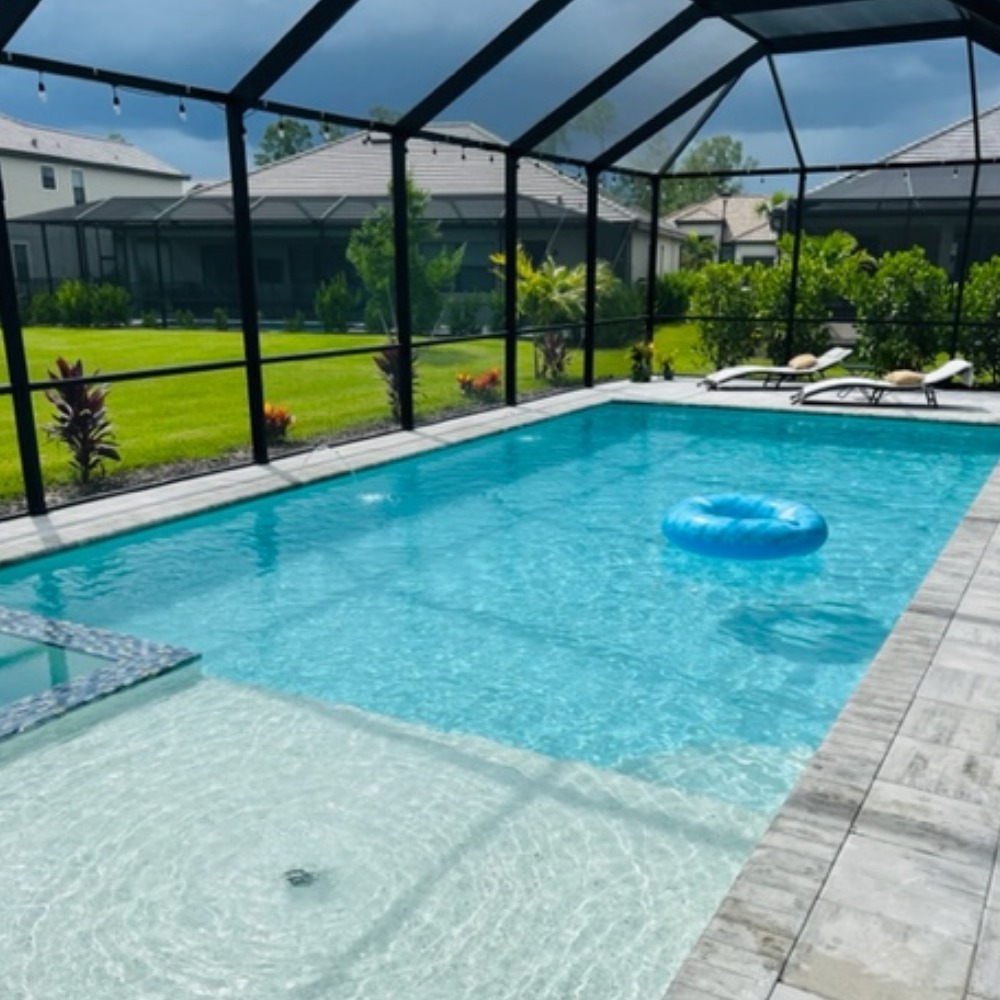
Every pool loses some water. Between our heat, the wind, and months where the sun barely lets up, evaporation alone can drop a Fort Myers pool a quarter inch or more a day. So when a homeowner calls asking how to tell if their pool is leaking, the first honest answer is that not every drop in the water level means you have a pool leak. We get this call a lot, usually from someone who’s been topping off the pool every few days for weeks and finally wants a straight answer instead of a guess.
But some drops aren’t evaporation, and the signs are usually there if you know what to look for. This guide walks through the real warning signs, how evaporation actually behaves in our climate, how to run the bucket test at home, where pools in Southwest Florida tend to leak, and when it’s time to stop guessing and call in pool leak detection equipment that can actually find the source.
Evaporation vs. a Real Pool Leak in Southwest Florida
Our climate makes this harder to judge than it is up north. Summer heat, near constant wind off the Gulf, and long stretches of low humidity all push evaporation rates up, and the effect isn’t uniform across every backyard. A screened pool typically evaporates slower than one left open to full sun and wind, because the screen cuts down direct airflow across the surface. An exposed pool on a windy lot near the water, on the other hand, can lose noticeably more just from the breeze pulling moisture off the surface all day.
Heat plays its own role too. The bigger the gap between water temperature and air temperature, the faster water evaporates, which is part of why a freshly filled pool in the peak of a Fort Myers summer afternoon can seem to disappear faster than the same pool in the milder months. Solar covers and pool covers slow this down considerably when they’re actually used, which is worth remembering if you’ve stopped using one and started noticing bigger water level swings.
On top of all that, our rainy season runs roughly June through September, and a couple inches of rain overnight can raise the water level enough to mask a leak that’s been quietly draining the pool the rest of the week. This is one of the most common reasons a leak goes unnoticed here longer than it would somewhere with a more predictable climate. Homeowners see the pool “full” after a storm and assume everything is fine, when the storm just reset the clock on a problem that was already there.
A general rule of thumb, and one most pool professionals use as a starting point, is that normal evaporation runs about a quarter inch of water loss per day, sometimes a bit more during our hottest, windiest stretches, or on a pool with a lot of exposed surface area relative to its volume. If your pool is consistently losing more than that, especially with the pump running, the cover off, and no obvious weather explanation, that gap is worth investigating rather than topping off and moving on to the next thing.
Signs Your Pool Is Leaking
Water level dropping is the most obvious clue, but it’s rarely the only one. Here’s what else tends to show up when a pool actually has a leak, rather than just losing water to the sun and wind.
| Sign | What It Usually Means |
|---|---|
| Water level drops faster than evaporation alone explains | Likely leak in the shell, plumbing, or a fitting |
| Cracks in the pool deck, coping, or shell | Water may be escaping through the crack itself or nearby plumbing |
| Soggy, sinking, or eroding spots around the pool | Water is surfacing from an underground leak in the plumbing |
| Air bubbles spitting from the return jets | Suction-side plumbing is pulling in air where it should be pulling water |
| Chemistry that won’t hold no matter how much you add | Fresh water leaking in (or pool water leaking out) keeps diluting your balance |
| Algae or chlorine demand that keeps climbing | Related to chemistry instability from ongoing water loss |
| Unusually high water bill | The pool (or an auto-fill line) is quietly pulling extra water from the house supply |
| Puddles or wet ground around the equipment pad | A pump, filter, or plumbing fitting near the equipment is leaking |
Water level dropping faster than it should. This is the one everyone notices eventually, but the timeline matters. Evaporation losses tend to be gradual and fairly consistent day to day. A leak often shows a steeper, sometimes uneven drop, particularly if the leak is pressure-driven and worse while the pump is running.
Cracks in the deck, coping, or shell. Not every crack means a leak, but a crack that’s damp, growing, or paired with a dropping water level is worth taking seriously. Soil movement and settling are common in Southwest Florida, and cracks are often the first visible clue that something below the surface has shifted.
Soggy or sinking ground around the pool. If a patch of lawn or landscaping near the pool stays wet without rain, or if the ground has started to sink slightly, that’s often water finding its way up from an underground plumbing leak rather than surface runoff.
Air bubbles from the return jets. This one’s specific to plumbing on the suction side, meaning the lines pulling water toward the pump. If a line has a leak, it can pull in air instead of water and push that air out through the returns, which shows up as visible bubbles in the pool.
Chemistry that won’t hold. If you’re adding chemicals and testing normal, only to find the same imbalance again a few days later, a leak that’s constantly diluting the water with fresh fill water (or letting treated water escape) can be part of the reason.
Rising chemical or algae demand. Related to the point above, a pool that keeps needing more chlorine or more attention to avoid algae, without an obvious cause like heavy bather load or extra rain, can be fighting a losing battle against a leak diluting its chemistry.
A water bill that jumped for no clear reason. An auto-fill valve hides a lot of leaks by quietly topping the pool off from the house’s water supply. If your bill went up and nothing else changed at home, the pool is worth checking before you assume it’s unrelated.
Puddles or wet ground at the equipment pad. This is one of the more straightforward signs, since it usually points to a specific pump, filter, or fitting rather than something buried and out of sight.
If you’re seeing two or more of these at once, that’s a stronger signal than a single symptom on its own. A pool inspection is a good next step if you’re not sure whether what you’re seeing adds up to a leak or a maintenance issue.
The Bucket Test, Step by Step
The pool leak bucket test is the standard first step for a reason. It’s simple, it costs nothing, and it separates evaporation from an actual leak better than watching the water level alone ever will, because it gives you a built-in control group floating right in the same pool.
Here’s how to run it:
- Fill a bucket with pool water and set it on a step or ledge in the pool so it’s partly submerged, floating roughly at the same depth the pool’s waterline sits. Using pool water instead of tap water keeps the temperature and evaporation behavior consistent with the pool itself.
- Mark the water level inside the bucket with a piece of tape or a marker, right at the surface. A strip of painter’s tape works well because it won’t slide once it’s wet.
- Mark the pool’s water level on the outside of the bucket or on the pool wall next to it, at the same height as your first mark, so you have two clean reference points to compare later.
- Turn off the auto-fill valve, if your pool has one, so it doesn’t mask the results by quietly refilling the pool while the test is running.
- Skip backwashing, extra swimming, or topping off during the test window if you can help it. Heavy splashing, a full pool party, or a manual top-off will all throw off the comparison.
- Wait 24 to 48 hours, keeping the pump running on its normal schedule so the test reflects real, everyday conditions rather than a pool sitting idle.
- Compare the two marks. If the pool’s water level has dropped noticeably more than the level inside the bucket, evaporation isn’t the full story. Both should drop by roughly the same amount if evaporation is the only thing happening; a gap beyond about a quarter inch of extra loss points toward a leak. If you want more confidence in the result, running the test twice on two separate days is a reasonable way to rule out a one-off fluke like an unusually windy afternoon.
The bucket test for pool leak detection won’t tell you where the leak is, only that one likely exists. That part takes equipment and a trained eye, which is where a proper pool leak detection visit comes in.
Where Pools Usually Leak
Once the bucket test points to a real leak, the next question is how to find a leak in a pool without tearing up the whole yard guessing. In our experience working across Fort Myers, Cape Coral, and the surrounding area, leaks tend to show up in a handful of predictable places, and older pools with more years of ground movement behind them tend to develop more of these over time.
Plumbing lines. Underground pipes between the pool and the equipment pad are one of the most common culprits, especially at joints and fittings that have shifted slightly with soil settling over the years. Southwest Florida’s sandy soil and heavy seasonal rain can accelerate this kind of gradual settling more than firmer ground would.
Skimmer. The skimmer housing can crack where it meets the pool wall, or the seal around it can degrade, letting water seep out slowly enough to go unnoticed for weeks. Because the skimmer sits right at the waterline, a leak here can also mimic evaporation at first glance, since the water level simply creeps down along the same edge you’d expect it to from the sun and wind anyway.
Light niche. The fitting around an underwater light is a known weak point, and the conduit running to it can carry water to surface somewhere else entirely, which is part of why leak detection isn’t as simple as “look where it’s wet.” Water can travel along a conduit for several feet before it ever shows up above ground, which is exactly the kind of misleading clue that leads homeowners to dig in the wrong spot.
Shell or liner. Cracks in a gunite or shotcrete shell, or a tear in a vinyl liner, leak directly from the point of damage. These are sometimes visible along the pool’s interior finish, and sometimes not, particularly on darker finishes or below the waterline where a small crack is easy to miss during a casual look.
Equipment pad. Pumps, filters, heaters, and the plumbing connecting them all have seals, gaskets, and unions that can fail with age or heavy use. A puddle at the pad is one of the more straightforward signs to catch, and it’s worth checking during a routine pool equipment repair visit even if you’re not sure the equipment pad is actually the source of the water loss.
Why Professional Pool Leak Detection Matters
It’s tempting to start digging where you think the leak is, but guessing is exactly how homeowners end up with an expensive hole in the yard and still no closer to a fix. Professional pool leak detection uses a few specific methods to actually confirm the location before anyone breaks ground:
- Pressure testing isolates individual plumbing lines to see which one is losing pressure, narrowing down the problem to a specific run of pipe rather than the whole system. This step alone rules out entire sections of plumbing that are perfectly fine, which saves a lot of unnecessary digging later.
- Dye testing introduces a visible dye near a suspected crack, fitting, or light niche underwater, so a technician can watch exactly where the water carries it and confirm the escape point directly rather than inferring it.
- Electronic listening equipment can pick up the sound of water moving through a crack in a pipe that’s otherwise buried and completely invisible from the surface, which is often how a plumbing leak several feet underground finally gets pinpointed without digging up the whole yard to find it.
- A visual inspection of the shell, fittings, and equipment rounds out the process, since some leaks, like a cracked return fitting or a failing pump seal, are found simply by a trained eye knowing exactly where to look and what a failing component looks like up close.
Used together, these methods usually pinpoint a leak precisely enough that repairs are targeted instead of exploratory. That matters for your yard, your landscaping, and honestly for your wallet too, since digging in the wrong spot doesn’t fix anything and just adds another repair to the list.
What Pool Leak Detection Costs
Pool leak detection cost depends on where the leak is, how it’s confirmed, and what it takes to repair once it’s found. A skimmer seal is a different job than a break in an underground plumbing run, and a light niche fitting is different again, so we’re not going to throw out a single number that doesn’t reflect your actual pool. What we can promise is that we diagnose first and price second. We provide a written estimate once the leak is confirmed and located, so you know exactly what you’re paying for, and why, before any work starts. There’s no scenario where we start cutting into a deck or digging up plumbing on a guess and hand you a bill afterward. If you’re weighing whether a repair is worth scheduling right now versus waiting, our post on when to schedule pool repairs to avoid bigger expenses is worth a read too, since a leak is a good example of a problem that tends to get more expensive the longer it sits.
What to Do Next
If the bucket test confirms more water loss than evaporation explains, or you’re seeing cracks, soggy ground, air in the returns, or chemistry you can’t keep balanced no matter what you add, it’s time to have it looked at properly. Waiting rarely helps. A slow leak wastes water and chemicals every single day it goes unaddressed, and depending on where it sits, it can undermine decking, erode soil, or stress the structure around the pool over time. What starts as a minor annoyance and a slightly higher water bill can turn into a much bigger repair if it’s left alone long enough.
A pool inspection is a good starting point if you’re not sure whether the issue is a leak, an equipment problem, or something else entirely, and it’s a lower-commitment way to get a professional set of eyes on the situation. If a leak has already damaged the shell, deck, or surrounding area, our pool renovations team can handle the repair once the source is confirmed and the scope of the damage is clear. And if you’d rather catch these things early, before they turn into a guessing game at all, weekly pool service includes a routine check of water level and equipment as part of every visit, so a slow leak has less time to hide.
Liquid Concepts Pool Service has been documenting exactly what we find, and what we do about it, for families across Fort Myers, Cape Coral, Lehigh Acres, North Fort Myers, Estero, Bonita Springs, and Fort Myers Beach for over 60 years combined experience. We’re a Florida Certified Pool/Spa Contractor (#CPC 1459893), and every visit comes with a written record of what was tested, what was found, and what we recommend, no upsells, no surprise add-ons.
If your pool is losing more water than it should, don’t start digging on a guess. Call us at (239) 526-8830 or contact us to schedule pool leak detection, and see what homeowners in Fort Myers, Cape Coral, and Bonita Springs say about working with us in our reviews.
FAQ
How do I tell if my pool is leaking or just evaporating?
Run the bucket test. If your pool loses noticeably more water over 24 to 48 hours than a floating bucket of pool water loses over the same period, evaporation isn’t the full explanation, and a leak is likely.
How does the bucket test work?
Fill a bucket with pool water, set it partly in the pool at the same depth as the waterline, mark the level inside the bucket and the level in the pool, then compare after 24 to 48 hours with the pump running normally. Roughly equal drops point to evaporation; a bigger drop in the pool points to a leak.
How much does pool leak detection cost?
It varies depending on where the leak is and what method confirms it, whether that’s pressure testing, dye testing, or electronic listening equipment. We provide a written estimate once the leak is diagnosed.
Where do pools usually leak?
The most common spots are underground plumbing lines, the skimmer housing, the light niche fitting, the pool shell or liner itself, and seals or unions around the equipment pad.
How much water loss is normal for a pool?
In Southwest Florida’s heat and wind, roughly a quarter inch of evaporation per day is typical, sometimes more during especially hot or windy stretches. Water loss beyond that, especially if it holds steady regardless of weather, is worth checking with a bucket test.
Ready to find out for sure? Call Liquid Concepts Pool Service at (239) 526-8830 or contact us to schedule pool leak detection and get a clear answer, documented in writing, no guessing required.